

Cart
0
Read time: 5 minutes
You have great products. You're consistent. You're doing everything you think is right — and yet your skin still isn't giving you the results you expected.
Here's a question worth asking: are you applying your products in the right order?
Because here's the truth most people don't realise the order you layer your skincare matters almost as much as the products themselves. Apply a thick moisturiser before your serum, and the serum physically cannot penetrate. Apply your SPF before your moisturiser, and you've compromised both. Get the sequence wrong consistently, and you're using expensive products at a fraction of their effectiveness.
This post sets the record straight the correct skincare layering order, morning and evening, with exactly why each step belongs where it does.

The One Rule That Governs Everything
Before we go step by step, here is the single principle behind correct skincare layering:
Thinnest to thickest. Lightest to heaviest. Water-based before oil-based.
This rule exists because of skin physics. Lightweight, water-based products have small molecules that absorb directly into the skin. Thicker creams and oils have larger molecules that sit closer to the surface sealing in what's underneath. If you apply a heavy cream before a lightweight serum, the serum has no pathway into the skin. It sits on top of the cream and largely evaporates.
The sequence is not a preference. It's the logic of absorption.
The Correct Morning Skincare Order
Your morning routine has one overarching goal: cleanse, treat, and protect.
Step 1 — Cleanser
Why it goes first: Everything starts on clean skin. Overnight, your skin produces sebum, dead skin cells accumulate, and your nighttime products are sitting on the surface. A gentle cleanser removes all of this so your subsequent products absorb into clean skin — not into a layer of overnight residue.
Common mistake: Using a harsh, stripping cleanser that disrupts the skin's pH and leaves skin tight before any other product goes on. A cleanser should leave skin feeling comfortable not squeaky clean.
→ Shop Cleansers at DiasBeauty
Step 2 — Toner
Why it goes second: After cleansing, your skin's pH can be slightly disrupted. A toner restores this balance and depending on its formulation hydrates, preps, or lightly treats the skin before anything else goes on. Think of it as the primer coat before painting a wall.
Common mistake: Skipping toner entirely, or using an alcohol-heavy toner that strips rather than preps. A good toner either hydrates, balances, or gently treats never dries.
Application tip: Pat into skin with clean hands rather than wiping with a cotton pad you absorb more product and waste less.
Step 3 — Serum
Why it goes third: Serums are your most concentrated, targeted treatment products. They contain the smallest molecules of any step designed to penetrate deep into the skin and deliver active ingredients directly where they're needed. This is why they go on before moisturiser, not after.
Common mistake: Applying serum over moisturiser. The moisturiser creates a barrier the serum cannot penetrate you've just put the most effective product in your routine on the outside of a barrier.
Morning serums to prioritise:
- Vitamin C — antioxidant protection against UV-triggered pigmentation, morning is the optimal time
- Niacinamide — regulates sebum, reduces inflammation, blocks melanin transfer
- Hyaluronic acid — floods skin with moisture before sealing it in
Allow your serum 30–60 seconds to absorb before the next step.
Step 4 — Moisturiser
Why it goes fourth: Your moisturiser has two jobs delivering hydration and sealing in everything applied before it. It creates a protective layer that locks your toner and serum underneath, preventing moisture loss throughout the day.
Common mistake: Skipping moisturiser if your skin is oily. This is one of the most widespread skincare errors. Skipping moisturiser tells your skin it's dry and it responds by overproducing oil. Oily skin needs moisturiser. It just needs the right one a lightweight, oil-free gel formula rather than a heavy cream.
→ Shop Moisturisers at DiasBeauty
Step 5 — SPF (Last, Always)
Why it goes last: Sunscreen needs to sit on the outermost layer of your skin to form an effective protective barrier. If you apply moisturiser or anything else over it, you dilute and disrupt that barrier and your UV protection drops significantly.
Common mistake: Applying SPF underneath moisturiser, or mixing SPF into your moisturiser and calling it done. Neither works properly. SPF is the final step. Always.
For chemical SPF: Apply at least 15–20 minutes before sun exposure it needs time to activate. For mineral SPF, protection is immediate on application.
→ Shop Sunscreen at DiasBeauty

The Correct Evening Skincare Order
Your evening routine has a different goal: cleanse, treat, and repair.
Night is when your skin goes into active repair mode cell turnover accelerates, collagen production peaks, and your skin is most receptive to treatment ingredients. The evening is your best opportunity to use your strongest actives.
Step 1 — Double Cleanse
Why it goes first: If you wore SPF or makeup during the day which you should have a single cleanser often isn't enough. SPF is designed to be tenacious. Start with an oil-based cleanser or micellar water to dissolve it, then follow with your regular water-based cleanser to remove remaining residue.
Common mistake: Skipping double cleansing and applying treatment products over a layer of unremoved SPF. Your actives are now sitting on top of sunscreen, not your skin.
→ Shop Cleansers at DiasBeauty
Step 2 — Toner
Same logic as the morning restore pH and prep the skin for treatment absorption. If you're using an exfoliating toner (AHA or BHA), this is when you apply it 2 to 3 times per week only, not daily. On exfoliation nights, skip Step 3 and go straight to moisturiser.
Step 3 — Treatment Serum or Active
Why it goes third: This is your deepest treatment step the ingredients that target your specific skin concern at a cellular level. Evening is the optimal time because there's no SPF interaction, no sun exposure, and your skin's repair processes are at their peak.
Evening actives by concern:
- Hyperpigmentation and dark spots → Tranexamic Acid, Alpha Arbutin, Niacinamide + TXA
- Acne and oily skin → Salicylic acid (BHA) serum
- Ageing, fine lines, texture → Retinol (start slowly — once a week, build up over months)
- Dry or dehydrated skin → Hyaluronic acid or barrier-repair serum
Common mistake: Layering multiple strong actives in one evening routine. Retinol + AHA + BHA on the same night is a recipe for a compromised barrier. One treatment per night rotate if needed.
Step 4 — Moisturiser
Seal everything in and support overnight barrier repair. Evening moisturisers can be richer than daytime you have 6–8 hours of absorption time with no heat or pollution to contend with. Look for ceramides, peptides, or shea butter in your night formula.
→ Shop Moisturisers at DiasBeauty

Your Complete Layering Guide at a Glance
| Step | Morning | Evening |
|---|---|---|
| 1 | Cleanser | Oil cleanser + Water cleanser |
| 2 | Toner | Toner (or exfoliant 2–3x/week) |
| 3 | Serum (Vitamin C / Niacinamide) | Treatment serum (TXA / Retinol / BHA) |
| 4 | Moisturiser | Rich moisturiser |
| 5 | SPF — always last | — |
The 5 Layering Mistakes That Are Costing You Results
① SPF before moisturiser — SPF needs to be the outermost layer. Anything applied over it dilutes UV protection.
② Serum after moisturiser — Moisturiser creates a barrier. Serum applied after cannot penetrate it. Always serum first.
③ Skipping the wait time — Apply each layer, give it 30–60 seconds to absorb, then move to the next. Layering too fast causes pilling and reduces absorption.
④ Multiple actives on the same night — Retinol and AHA together, or BHA and retinol together, causes over-exfoliation and barrier damage. One active per night.
⑤ Mixing SPF into moisturiser — Diluting SPF reduces its effectiveness. They are separate steps for a reason.
One More Thing — Does Layering Order Matter for Toners?
Yes. And specifically for those who use both a hydrating toner and an exfoliating toner — they don't go on together.
- Hydrating toner — goes on after cleansing, every day, AM and PM
- Exfoliating toner (AHA/BHA) — goes on after cleansing, 2–3 evenings per week only, in place of the hydrating toner on those nights
Never layer an exfoliating toner on top of a hydrating toner in the same routine the exfoliant needs direct contact with the skin to work at full strength.
The Bottom Line
Great products are half the equation. The order you apply them is the other half. Get both right, and every product in your routine performs at its full potential nothing is wasted, nothing is blocked, and your skin gets the results it's actually capable of.
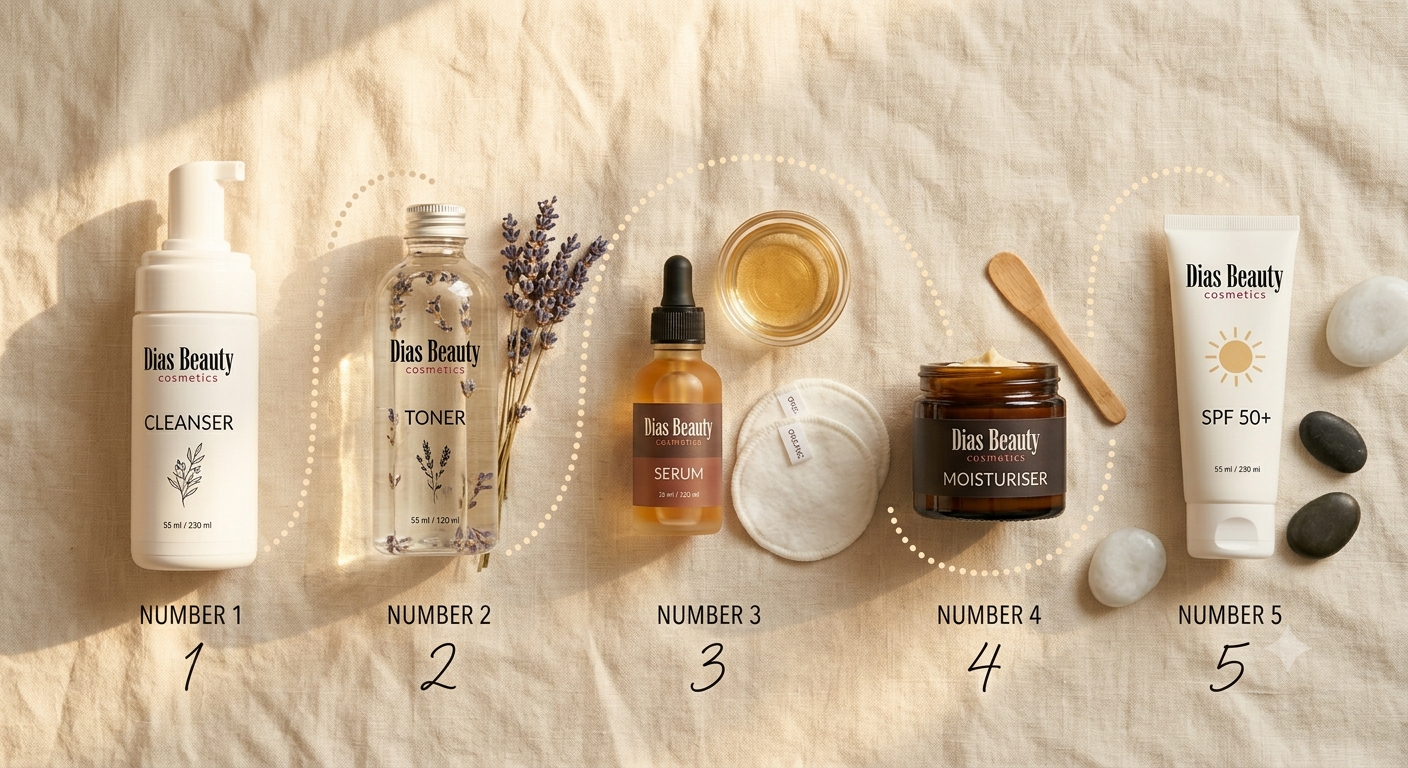
The sequence, every time: Morning: Cleanser → Toner → Serum → Moisturiser → SPF Evening: Double Cleanse → Toner → Treatment Serum → Moisturiser
That's it. Simple, consistent, effective.
Browse the full DiasBeauty skincare range — Cleansers, Serums, Moisturisers, Sunscreen — all 100% authentic, sourced directly from certified brand distributors. Unsure which products to fill each step with? Message us on Instagram @Diasbeauty_cosmetics or WhatsApp. We'll help you build the right layering routine for your skin.
About Author

Etiam vel magna sed leo feugiat cursus. Cras mollis blandit dolor. Praesent vulputate justo quis volutpat pharetra. Suspendisse
Recent Post


Tags


