

Cart
0
Read time: 6 minutes
This is Chapter Two of our skincare series. If you missed Chapter One — where we broke down how to identify your skin concern before choosing any product — read it here.
You now know your skin concern. You understand what problem you're trying to solve. So what comes next?
Building the routine. And this is where most people get it wrong, not because they're using bad products, but because they're using good products in the wrong order, at the wrong time, or in the wrong combination.
The sequence of your skincare routine is not arbitrary. It follows a logic, thinnest to thickest, treatment before moisture, protection last in the morning and when you get it right, every product performs better. When you get it wrong, products can cancel each other out, cause irritation, or simply sit on the surface of your skin without absorbing properly.
This is your complete, beginner-friendly guide to building a skincare routine from scratch morning and evening with the right steps, in the right order, for real results.
The Golden Rule: Thinnest to Thickest
Before we get into steps, here is the one principle that governs skincare routine order: apply products from the thinnest consistency to the thickest.
Water-based, lightweight products go first so they can absorb directly into the skin. Thicker creams and oils go last to seal everything in. If you apply a thick cream before a lightweight serum, the serum cannot penetrate the barrier the cream creates and it simply evaporates off the surface.
Keep this rule in mind as we walk through each step.

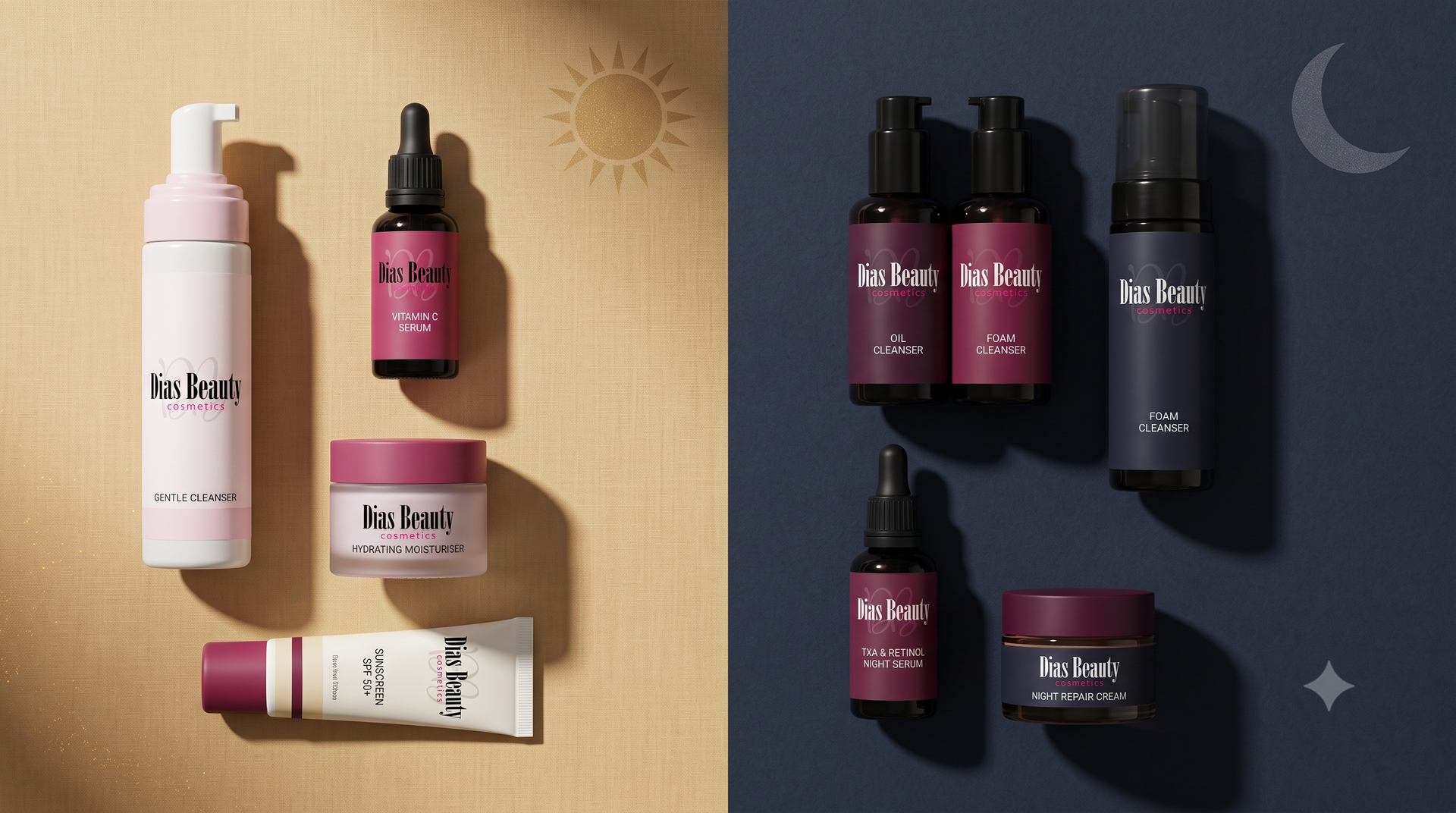
Your Morning Skincare Routine → Step by Step
The goal of your morning routine is simple: cleanse, protect, and defend. You're preparing your skin to face the day UV exposure, pollution, and environmental stressors while treating your skin concern at the same time.
Step 1: Cleanser
Every routine morning and evening starts with a cleanser. In the morning, your goal is to remove sweat, overnight skincare product residue, and any sebum that built up while you slept. You don't need anything harsh a gentle, pH-balanced cleanser is all you need.
Who needs what:
- Dry or sensitive skin → a cream or milk cleanser that doesn't strip
- Oily or acne-prone skin → a gentle foaming or gel cleanser that controls excess oil without over-drying
- Normal or combination skin → a balanced gel or low-foam cleanser
→ Shop Cleansers at DiasBeauty
Step 2: Toner (Optional but Powerful)
After cleansing, your skin's pH can be slightly disrupted. A toner restores that balance and prepares your skin to absorb everything that comes next. But as we covered in our toner post not all toners are the same. Choose based on your concern:
- Dehydrated or dry skin → hydrating toner with hyaluronic acid or glycerin
- Oily or acne-prone skin → balancing or clarifying toner with niacinamide or low-concentration BHA
- Dull or uneven skin → brightening toner with mild AHA (use at night only)
Apply by gently patting into the skin with clean hands not wiping with a cotton pad, which wastes product.
Step 3: Serum
This is the treatment step the most targeted, concentrated product in your routine. Serums are formulated with smaller molecules that penetrate deeper into the skin than moisturisers, which is why they go on before cream.
Match your serum to your concern: check out the previous blog post
- Dark spots and hyperpigmentation → Vitamin C serum in the morning (brightens + fights UV-triggered melanin)
- Acne and oily skin → Niacinamide serum (regulates sebum, reduces inflammation)
- Dehydrated skin → Hyaluronic acid serum (pulls moisture into the skin cells)
- Dull, uneven texture → Vitamin C or niacinamide (brightens and evens tone)
- Ageing and fine lines → Vitamin C in the morning, peptide serum if layering
Apply a few drops and press gently into the skin don't rub. Allow it to absorb for 30–60 seconds before the next step.
Step 4: Moisturizers
Once your serum has absorbed, apply your moisturizer to lock everything in and support your skin barrier. Even oily skin needs moisturiser skipping it causes your skin to overproduce sebum to compensate, making oiliness worse.
Match to your skin type:
- Dry skin → a rich cream with ceramides, shea butter, or squalane
- Oily or acne-prone skin → a lightweight, oil-free gel moisturiser
- Sensitive skin → a fragrance-free, ceramide-based formula
- Dehydrated skin → a water-gel formula with hyaluronic acid
→ Shop Moisturisers at DiasBeauty
Step 5: SPF — The Most Important Step of Your Morning Routine
Sunscreen is the final step of your morning routine and the single most impactful product in your entire skincare collection. No exaggeration. UV exposure is the number one cause of premature ageing, the main reason dark spots return after fading, and a direct trigger of melanin overproduction in darker skin tones.
Apply SPF 30 minimum every single morning indoors, outdoors, rainy days, harmattan season. Reapply every 2 hours if you're spending extended time outside.
SPF for dark skin tones: Look for chemical sunscreens or hybrid formulas that don't leave a white cast. Lightweight textures that sit comfortably under makeup are ideal for daily use.
→ Shop Sunscreen at DiasBeauty

Your Evening Skincare Routine → Step by Step
The goal of your evening routine is different: cleanse, treat, and repair. Night is when your skin goes into recovery mode cell turnover increases, collagen production peaks, and your skin absorbs active ingredients more effectively. This is when you do your deepest treatment work.
Step 1: Double Cleanse (If You Wore SPF or Makeup)
If you wore sunscreen, makeup, or both during the day and you should have a single cleanser often isn't enough to fully remove them. Start with an oil-based cleanser or micellar water to dissolve SPF and makeup, then follow with your regular water-based cleanser to remove any remaining residue.
Leaving SPF or makeup on overnight is one of the most common causes of clogged pores, breakouts, and dull skin. Don't skip this.
→ Shop Cleansers at DiasBeauty
Step 2: Toner
Same logic as the morning restore pH and prep the skin for treatment. In the evening, if you're using an exfoliating toner (AHA/BHA), this is the step to apply it 2 to 3 times a week only, not daily. On exfoliation nights, skip the treatment serum (Step 3) and go straight to moisturizer.
Step 3: Treatment Serum or Active
Evening is the prime time for your strongest treatment ingredients because your skin is in repair mode, and because some actives (retinol, AHAs) increase sun sensitivity and should only be used at night.
Evening treatment options by concern:
- Hyperpigmentation and dark spots → Tranexamic Acid, Alpha Arbutin, Niacinamide + TXA, or Kojic Acid serum
- Acne and breakouts → Salicylic acid serum or niacinamide
- Ageing and fine lines → Retinol (start 2x per week, build up slowly)
- Dry or dehydrated skin → Hyaluronic acid or barrier-repairing serum
Important: Do not layer multiple strong actives in the same evening routine. Choose one treatment per night and rotate if needed.
Step 4: Moisturizers
Seal and repair. Evening moisturizers can be richer than your daytime formula your skin has 6–8 hours to absorb and benefit without exposure to heat or pollution. Ceramide-rich or peptide-infused night creams work exceptionally well here to support overnight barrier repair.
→ Shop Moisturisers at DiasBeauty

The Weekly Add-On: Exfoliation
Chemical exfoliation using AHAs (like lactic or glycolic acid) or BHAs (like salicylic acid) is not a daily step. It belongs in your routine 2 to 3 times a week, in the evening, as either a toner or a serum. Its job is to dissolve dead skin cells that dull the complexion and prevent your other products from absorbing properly.
AHAs (lactic acid, glycolic acid) work on the surface best for dull skin, dark spots, uneven texture. BHAs (salicylic acid) penetrate into pores best for oily, acne-prone, or congested skin.
Never use physical scrubs with harsh beads on your face they create micro-tears in the skin, cause inflammation, and can worsen hyperpigmentation in darker skin tones.
Supporting Your Skin From the Inside Out
A skincare routine works on the outside, but what you put inside your body matters too. Collagen production, hydration levels, and inflammation — three of the biggest factors in how your skin looks and behaves — are all influenced by nutrition and supplementation.
Our Supplements collection includes Vitamin C, collagen, and other skin-supporting formulas that complement your topical routine and work at a level no serum can reach.
Your Complete Routine at a Glance

One Routine Won't Fit Every Skin
This is a universal framework not a one-size-fits-all prescription. Your skin concern (which you identified in Chapter One) determines which products fill each step. A beginner with oily, acne-prone skin will use different cleansers, serums, and moisturizers than someone dealing with dry skin and hyperpigmentation but the structure of the routine is the same.
That's the point of this series. The structure is the foundation. The products are the tools. Choose both with intention, not guesswork.
Browse our full skincare collection to shop every product category in this routine all 100% authentic, sourced directly from certified brand distributors. Or message us on Instagram @diasbeauty_cosmetics and we'll help you personalize each step to your skin.
Next in the series: How to Introduce Actives Into Your Routine Without Damaging Your Skin Barrier.
Browse all skincare categories at diasbeautycosmetic.com
About Author

Etiam vel magna sed leo feugiat cursus. Cras mollis blandit dolor. Praesent vulputate justo quis volutpat pharetra. Suspendisse
Recent Post


Tags


